


This article is part of a Soft Skills series created by ITech Progress, sharing practical insights on clear communication, critical thinking, and effective collaboration in the age of AI.
As AI adoption increases, so do the demands for alignment and clarity in software architecture. Wherever complex systems, diverse stakeholders, and new technological possibilities come together, technical expertise alone is no longer enough. What matters is the ability to clearly communicate architectural decisions, target visions, and system boundaries. This article explores why precise communication is a critical success factor in AI-related architecture initiatives and how it can be improved intentionally.
AI Is Changing the Way We Communicate
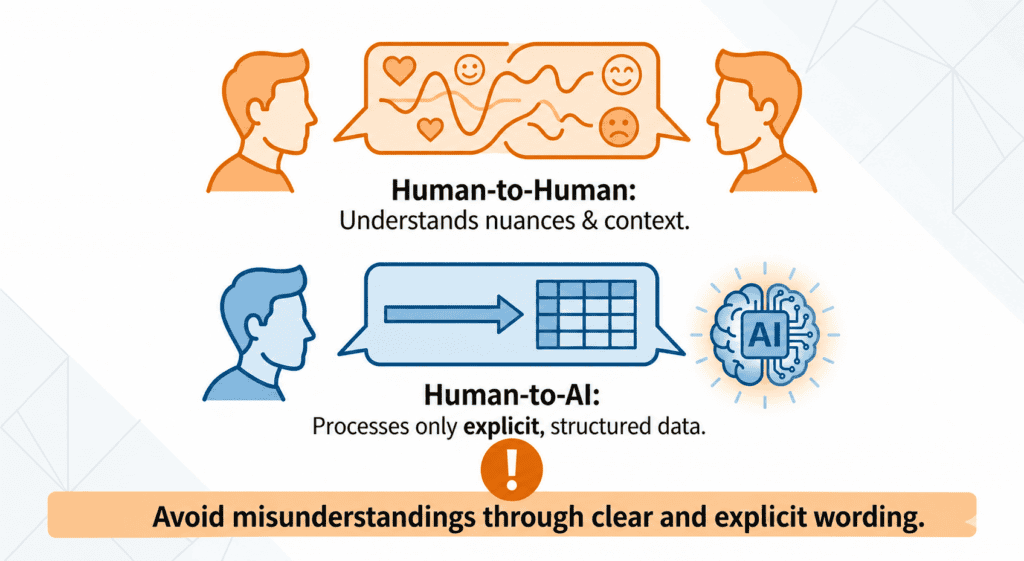
Artificial intelligence is increasingly influencing how people communicate and exchange information. Translation tools, chatbots, and assistance systems can accelerate processes, but they do not replace precise and conscious communication. This applies both in professional and private contexts.
AI systems interpret language strictly based on learned patterns from existing data and are not able to reliably capture implicit meanings or emotional nuances depending on context. Something left unsaid can easily be misunderstood or processed incompletely. This makes it even more important to foster clear, structured, and unambiguous communication. Only then can information be conveyed precisely and processed reliably – by both humans and AI systems.
The foundation for this lies in first reflecting on one’s own thoughts, interpretations, and the context of a topic and then organizing them into a structure and sequence that is understandable for both humans and machines.
For software architecture, this means formulating requirements, assumptions, and decisions so precisely that both AI systems and teams can clearly understand and reliably reuse them within the system context.
In teams, follow-up questions, body language, and facial expressions provide valuable feedback about how clearly we communicate. AI systems lack these feedback mechanisms, which means we must actively look for “gaps” in the AI’s contextual understanding. Even current “reasoning” or “thinking” AI systems do not independently disclose errors or gaps in their learned knowledge.
Precise Prompts Lead to Better Results
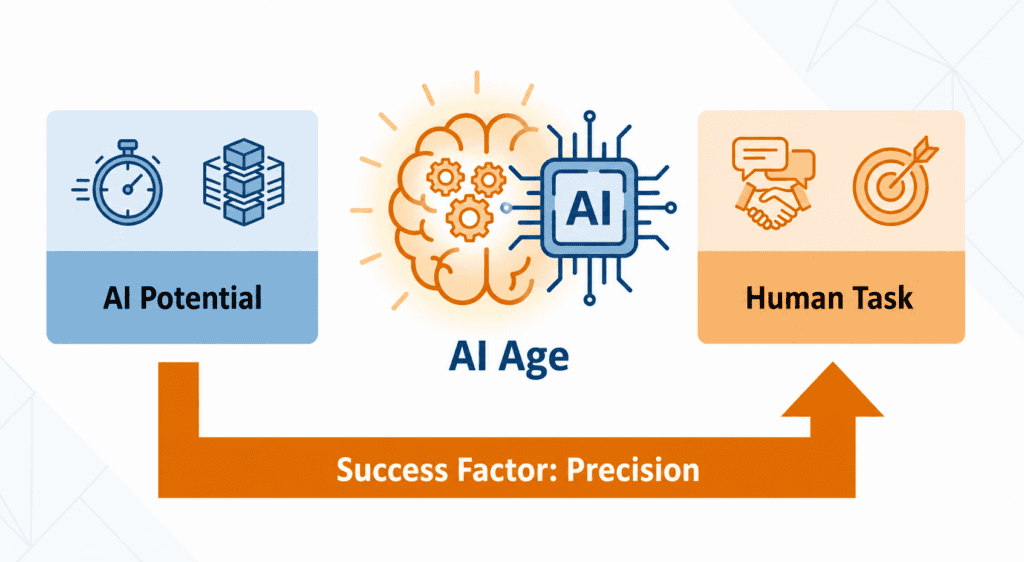
Anyone who wants to use AI effectively quickly realizes that good results are primarily achieved when prompts are formulated precisely, provide relevant context clearly and comprehensively, and define the intended goal unambiguously.
If a prompt follows a well-structured and reflective line of thought, high-quality results can be generated in fewer iterations and in less time. Anyone who wants to fully leverage the potential of AI should therefore be able to formulate context-rich, structured, and goal-oriented prompts – because the more precise the input, the better the result.
Repetitions or unnecessary paraphrasing within prompts can be counterproductive and may create unexpected effects. The context window of large language models (LLMs) is still significantly smaller and more error-prone than human contextual understanding. Prompts should therefore be as concise as possible and free from errors, contradictions, or redundancies.
Targeted communication techniques in prompts make it easier to identify and correct contextual gaps more quickly.
A New Competency Is Emerging: Cognitive Framing
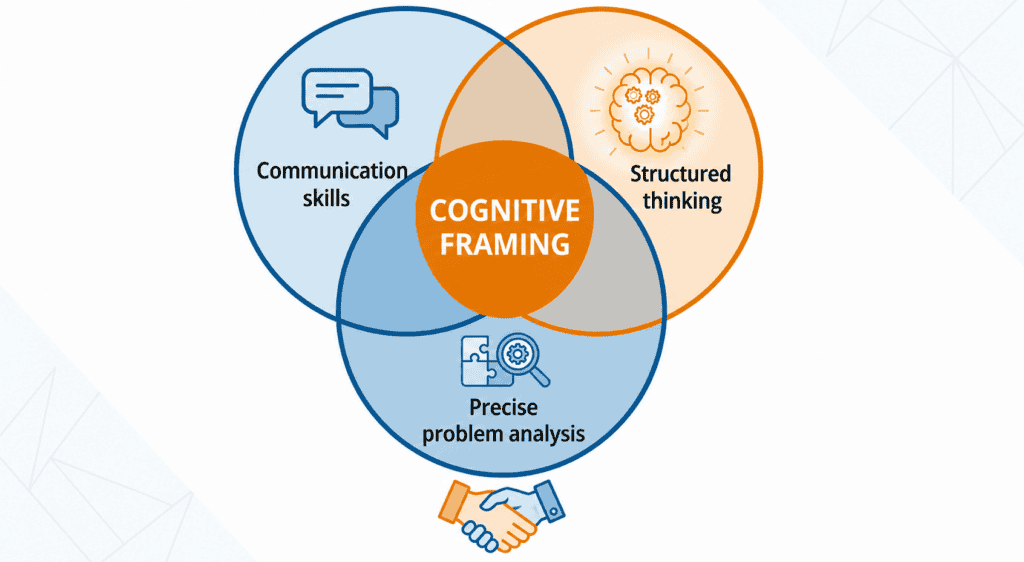
At a time when artificial intelligence is increasingly becoming part of everyday work, the ability known as cognitive framing is gaining importance.
This goes beyond simply giving clear instructions, as in prompt engineering. It involves formulating problems in a way that enables both humans and AI to work on them effectively and efficiently.
Cognitive framing combines communication skills, structured thinking, and precise problem analysis. Equally important is the ability to realistically assess the capabilities and limitations of AI.
This holistic approach makes it possible to better understand complex challenges and develop targeted solutions. In practice, this means focusing not only on the input itself, but also on how a problem is described from both a technical and domain perspective, and how collaboration between humans and AI is designed.
This creates a competency that helps organizations and professionals use AI purposefully and develop new ideas more effectively. Cognitive framing is therefore not just a technical aid, but an essential capability for collaboration in digital environments.
Critical Thinking as a Corrective When Working with AI
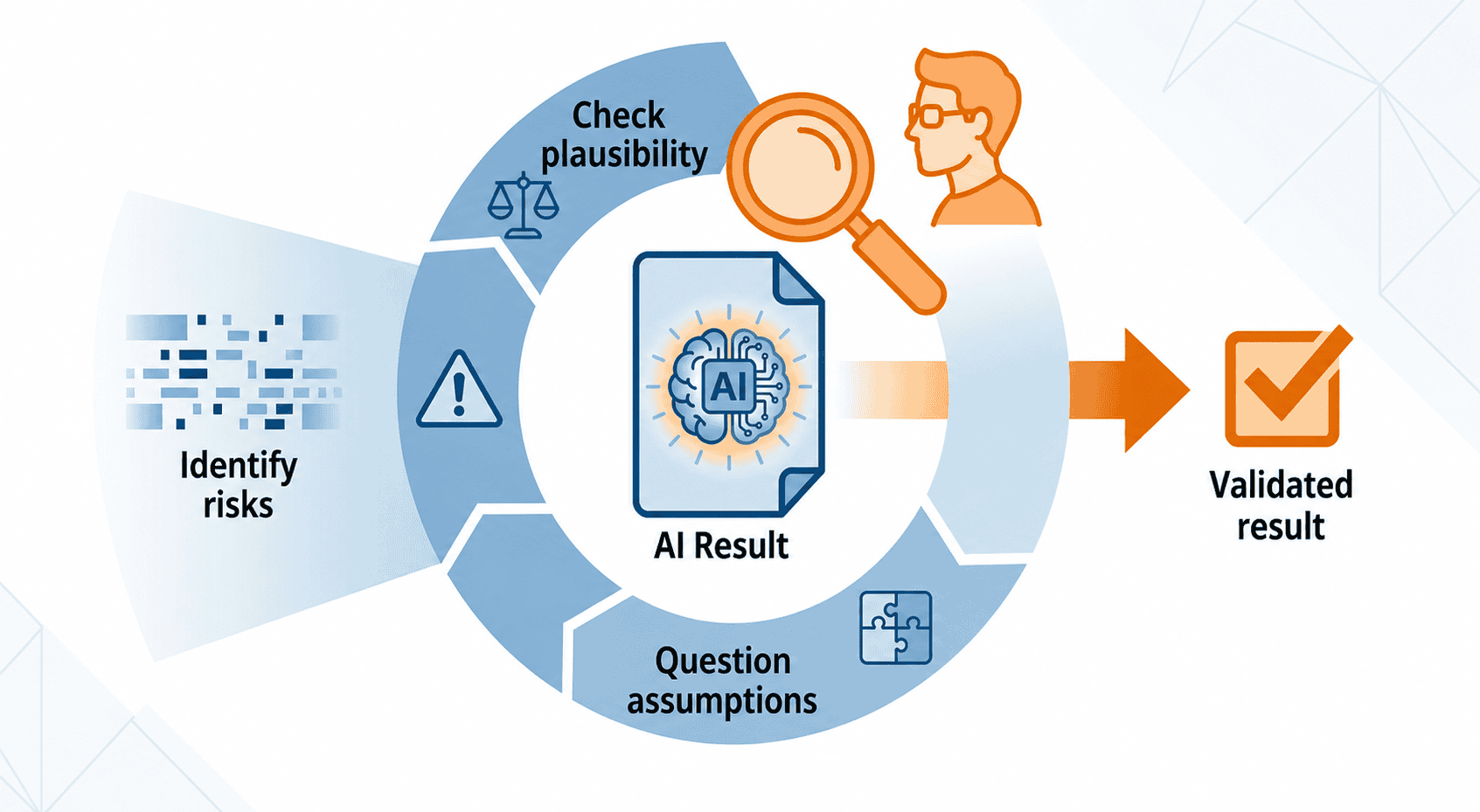
At a time when artificial intelligence is producing increasingly convincing answers, critical thinking becomes more important than ever. A seemingly coherent solution is not necessarily correct or complete.
As a result, experts are changing their role: instead of being pure problem-solvers, they increasingly become critical evaluators of results.
They ask essential questions such as:
• Is this answer plausible?
• Which assumptions were made, and are they justified?
• Which potential risks or overlooked factors could affect the proposed solution?
Only through a reflective and questioning mindset can the quality of results be ensured and poor decisions avoided.
Critical thinking therefore becomes an indispensable tool for using the potential of AI responsibly while recognizing its limitations. Experts must expand their capabilities to increasingly validate, contextualize, and safeguard results – a transformation that is impossible without critical thinking.
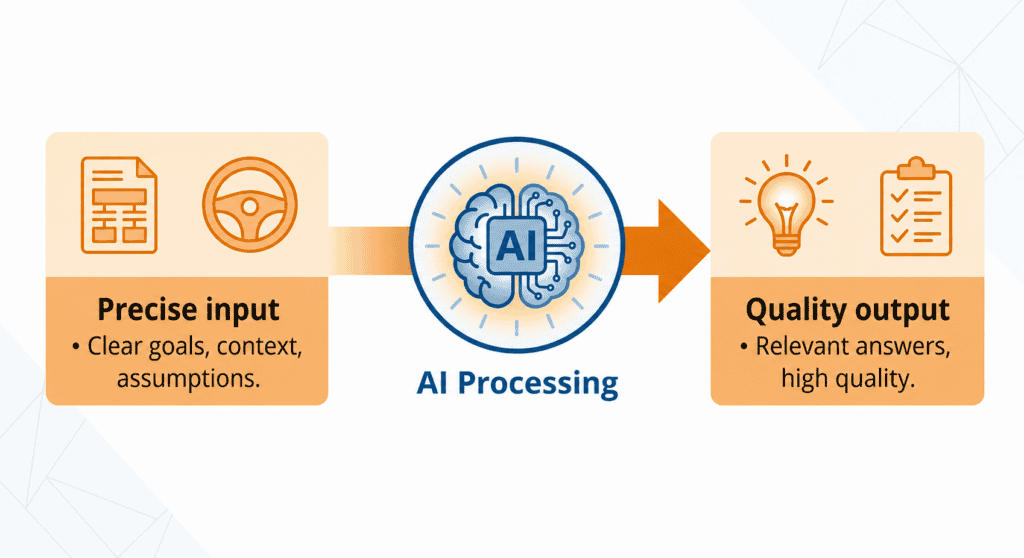
The productive use of AI does not begin with technology, but with clarity of thought and communication. Those who formulate problems precisely, structure prompts intentionally, critically evaluate results, and provide the right context create the foundation for collaboration that is not only more efficient, but also more reliable and resilient.
Sources
• The Importance of Clarity in Prompt Engineering
https://weclouddata.com/blog/the-importance-of-clarity-in-prompt-engineering/
• The Ultimate Guide to Prompt Engineering in 2026
https://www.lakera.ai/blog/prompt-engineering-guide
• From Humanlike Minds to Persuasive Machines: Anthropomorphism and Message Framing in AI Communication
https://discovery.researcher.life/article/from-humanlike-minds-to-persuasive-machines-anthropomorphism-and-message-framing-in-ai-communication/49e596c0bc853ee6a48b9797609e992b
• Critical Thinking in the Age of AI: Why Human-Machine Collaboration Is Shaping Our Future
https://www.sophiehundertmark.com/en/critical-thinking-and-human-ai-collaboration-2/
This is a translation of ITech Progress’ blog post “Klarheit im KI-Zeitalter: Warum präzise Kommunikation entscheidend wird”. Here you can find the original blog post in German.