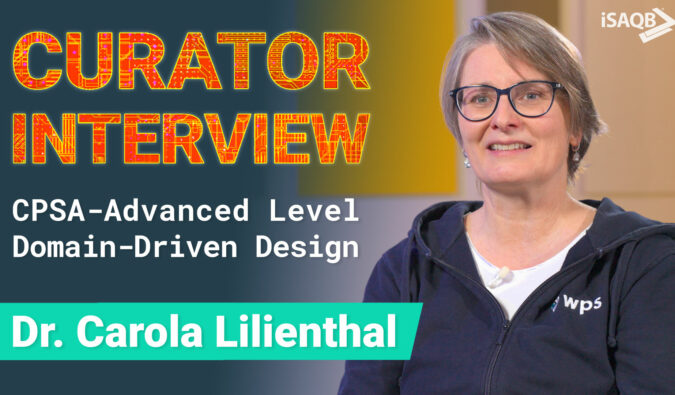
CPSA® Advanced Level & Domain-Driven Design: Building Real Architectural Competence
Video Interview with Carola Lilienthal, Curator of the CPSA® Advanced Module “Domain-Driven Design
In this interview, Dr. Carola Lilienthal – Curator of the CPSA® Advanced Level Module “Domain-Driven Design (DDD)” and long-standing member of the iSAQB community – shares her perspective on the value of iSAQB training and certification for both individuals and companies.
She explains why standards in software architecture education matter, how the CPSA® Foundation and Advanced Levels differ, and what makes the Advanced Level certification a true proof of architectural competence. Carola also provides deep insight into the philosophy behind Domain-Driven Design (DDD) and why it is far more than a technical technique – but rather an approach that connects software closely to business reality.
From vendor independence and standardized terminology to rigorous certification processes and networking opportunities, the interview highlights how iSAQB supports sustainable professional development in software architecture.
Key Takeaways
Why standards matter in software architecture
iSAQB was founded to create a shared body of knowledge and common terminology for software architecture. Standardized language and concepts significantly improve communication within and across companies.
A clear structure: Foundation and Advanced Level
The Foundation Level provides a broad, practice-oriented introduction to software architecture. The Advanced Level builds on that foundation with specialized modules and requires 70 credit points, a written architecture assignment, and an expert review.
Advanced certification as proof of real competence
The CPSA® Advanced Level certification is demanding and practice-based. Candidates must solve a realistic architectural challenge and defend their solution – making it a respected and meaningful credential.
Independence ensures quality
iSAQB separates curriculum development, training providers, and certification bodies into three independent parties. This structure safeguards neutrality, high quality standards, and vendor independence.
Domain-Driven Design as an approach, not a method
DDD helps architects move beyond purely technical thinking. It emphasizes deep understanding of the business domain, user needs, and the creation of a shared ubiquitous language between business and IT.
Bridging academia and real-world practice
While universities teach technical fundamentals, iSAQB training focuses on practical challenges: stakeholder communication, decision-making, and handling complexity in real projects.
Learning, networking, and professional growth
Advanced Level trainings provide not only knowledge, but also exchange with architects from different companies and domains. Conferences, meetups, and community engagement further strengthen professional development.
Carola also reflects on her motivation to shape the DDD curriculum and contribute to iSAQB’s mission: fostering high-quality, technology-neutral education that empowers architects to design better systems – and to communicate their decisions with clarity and confidence.
This interview is a must-watch for anyone considering the CPSA® Advanced Level, exploring Domain-Driven Design, or looking to strengthen their architectural expertise through structured, community-driven education.
Share this article:
Related Posts




- « Previous
- 1
- 2
- 3
- 4
- Next »